


COLUMN: Achieving Autocracy, One Amendment at a Time

For years, we occupied a rare place in South Asia’s political imagination: a small island nation that had, against the odds, transitioned away from autocracy and held competitive elections. That reputation did not rest on perfection. It rested on something more modest and more valuable, the presence of constraints. Power was contested. Institutions pushed back. Dissent, though often uncomfortable, still had room to exist. Today, that balance is no longer intact.
Under President Mohamed Muizzu, the erosion of democratic safeguards has not arrived through tanks in the streets or suspended constitutions. It has come through votes, amendments, and procedures being fast-tracked, thinly debated, and legally defensible on paper. That is precisely what makes the moment dangerous. Democracies rarely collapse all at once. They are hollowed out while still looking functional.
The central fact shaping everything else is political dominance. The ruling People’s National Congress now holds 66 of the 93 seats in Parliament, a supermajority large enough to alter constitutional architecture without meaningful opposition input. In late 2024, that power was exercised decisively. A package of constitutional amendments was passed in less than a day, including anti-defection provisions that strip legislators of their seats if they vote against party lines. Civil society groups warned correctly that such measures sever the link between representatives and voters. A legislature that cannot dissent is no longer a forum for accountability; it is a transmission belt for executive will.
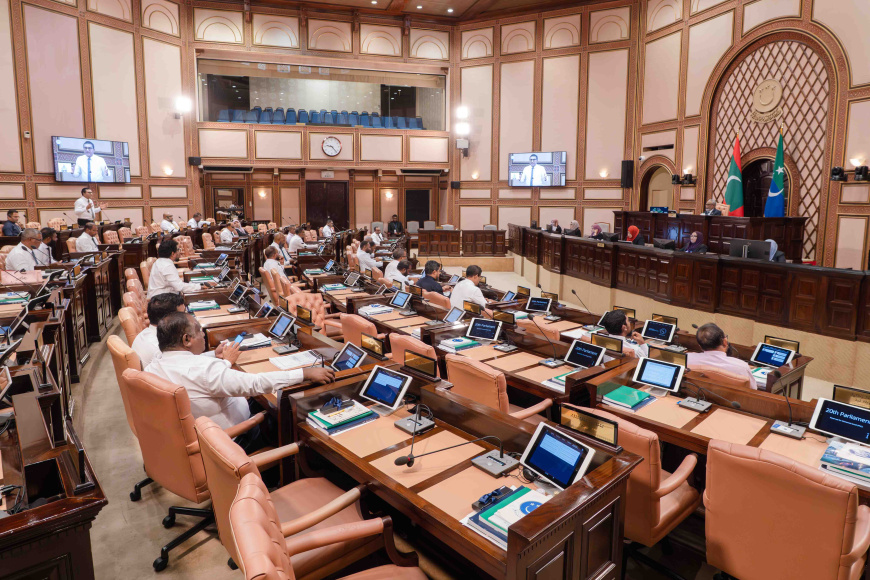
This is not an abstract concern. Parliamentary practice has visibly changed. Opposition lawmakers are routinely sidelined, expelled from sittings, or denied space to speak. During the passage of the Maldives Media and Broadcasting Regulation Act in September 2025, seven opposition MPs were physically removed from the chamber. Bills of sweeping consequence are introduced and passed within weeks, sometimes hours, with limited committee review and little public consultation. International observers have noted the absence of meaningful debate. When scrutiny disappears, lawmaking becomes ritual rather than restraint.
The impact is most evident in the realm of expression. One of the first institutions dismantled under the new legal framework was the independent media regulatory system. The 2025 media law abolished the Maldives Media Council and the Broadcasting Commission, replacing them with a single body partially appointed by the president. That body now holds the authority to fine or shut down outlets for offenses defined in vague, elastic terms: harming “honor,” spreading “fake news,” or offending religious values. The law’s defenders insist this is regulation. Journalists, rights groups, and the UN human rights office have warned it is censorship.
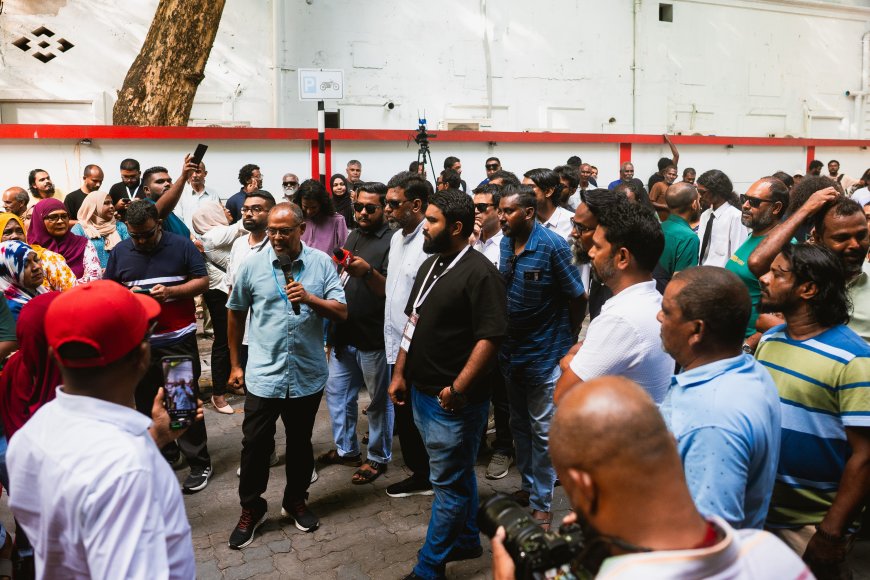
The chilling effect is no longer theoretical. Reporters protesting outside Parliament were detained by police; authorities denied the arrests despite photographic evidence. Television cameras have been blocked from capturing opposition speeches inside the chamber itself. Unsurprisingly, self-censorship is spreading. The Maldives’ sharp drop in global press freedom rankings over the past few years reflects not just new laws, but a new climate, one in which journalists understand the cost of crossing undefined lines.
Courts, traditionally the last refuge when politics fails, have not been spared. Amendments to the Judicature Act in 2024 weakened protections for Supreme Court justices, allowing removal without robust due process. In early 2025, three justices were suspended just as they were preparing to hear a challenge to the anti-defection law. Two were later impeached by Parliament, effectively freezing the Supreme Court’s work. One resigned, publicly alleging coercion by the executive. Pending constitutional cases vanished with them.
When judges are disciplined for the cases they are about to hear, the message is unmistakable.
Judicial independence does not need to be formally abolished to cease functioning. It collapses when judges understand that certain outcomes carry personal risk.
As institutional checks weaken, informal power fills the vacuum. Patronage has become increasingly visible in public appointments, diplomatic postings, and regulatory bodies. Critics describe a system where access to services and employment hinges on loyalty rather than merit. Transparency has eroded alongside this shift. Budget details go unpublished. Oversight commissions are dissolved quietly, without findings or accountability. Even basic disclosures, such as official travel expenses, have stopped appearing. Governance does not merely become inefficient under such conditions it rather becomes unaccountable.
Authoritarian consolidation often relies on more than procedure. It also requires narrative. The Muizzu administration has leaned heavily into religious-nationalist language, framing civic life as a moral struggle to defend faith, culture, and nation. Such rhetoric resonates in a homogeneous society, but it also narrows the boundaries of legitimate dissent. When political disagreement is recast as moral or religious deviance, compromise becomes betrayal. Critics are no longer wrong; they are suspect.
That narrowing is visible in policy toward minorities, particularly migrant workers, who constitute a significant portion of the population. Blanket police orders targeting migrants at night, justified by vague claims of public disorder, have been widely criticized as discriminatory. Collective suspicion replaces individual accountability. This is a familiar pattern in illiberal systems: social frustration is redirected toward those with the least power to respond.
Even decentralization, a quiet but meaningful reform of the post-2008 era has been reversed. Amendments to decentralization and planning laws have stripped elected island and atoll councils of real authority, pulling decision-making back to the capital. Local governance now exists largely in name. Institutions meant to enforce environmental protection or combat corruption report more directly to political superiors or are sidelined altogether. Public oversight fades, not because citizens stop caring, but because avenues for engagement are closed.
Taken individually, each of these developments can be defended as legal, temporary, or necessary. Taken together, they form a coherent pattern. Power is concentrated. Dissent is constrained. Oversight is neutralized. Participation is reduced to endorsement. This is not the collapse of democracy by force; it is its reengineering from within.
International watchdogs have begun to say as much. The Maldives is now classified as only partly free. Elections still occur. Laws are still passed. But the substance that gives those processes meaning: competition, scrutiny, and consequence is thinning.
The question, then, is not whether the Maldives still holds elections, but whether those elections can meaningfully change the direction of the state. Democracies do not die when ballots disappear. They die when ballots stop mattering.
None of this is inevitable. Democratic backsliding is reversible, but only while institutions retain some memory of independence and citizens retain some expectation of accountability. The longer power operates without constraint, the harder it becomes to restore those norms.
The Maldives’ democratic experiment was never guaranteed. It survived because limits were respected, even when inconvenient. The current moment tests whether those limits still exist or whether they are being quietly written out of the system. History suggests that once that line is crossed, it is rarely crossed back easily.












What's Your Reaction?