


A City Half Built, A Tunnel Never Begun: The Reckless Economics of Muizzu’s Vision

When President Mohamed Muizzu unveiled the Rasmale’ eco-city and the underwater tunnel connecting it to Malé, he presented them as the kind of bold, transformative ideas that would redefine the future of the Maldives. The imagery was striking: a carbon-neutral city rising from Fushidhiggaru lagoon, brimming with renewable energy, smart systems, and housing for tens of thousands; and beneath the sea, a tunnel with glass panels through which commuters could watch schools of fish shimmer as they traveled between islands.
Two years later, the romance faded. The projects, once touted as symbols of a new era, now resemble cautionary tales, the kind of grand political promises that collapse under the weight of fiscal reality. What is becoming increasingly clear is that these mega-projects were announced long before the financial, technical, or environmental foundations were in place. The result is a set of initiatives too expensive to ignore and too unrealistic to deliver.
Rasmale’: A Mega-City Without a Master Plan
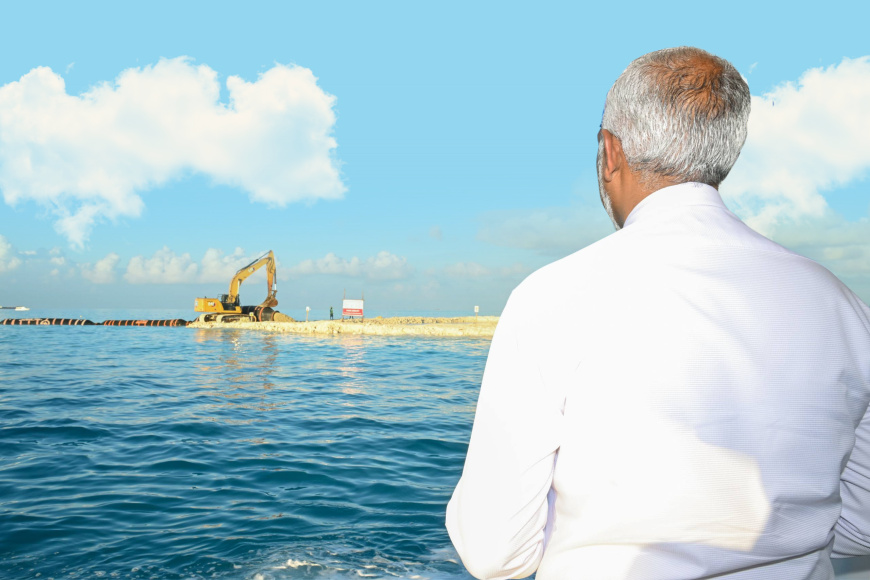
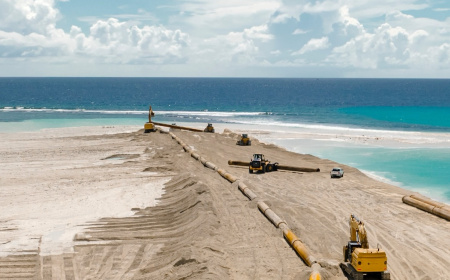
Rasmale’ began with a pledge that reclamation would be completed within eight months, a timeline that engineers privately described as unrealistic from the outset. That promise was not met. The initial contract with the Sri Lankan firm CMCC collapsed amid delays and controversy, forcing the administration to find new contractors and new financing arrangements.
Today, reclamation is nowhere near complete. The project’s pace has been inconsistent and frequently stalled, and the government is only now commissioning a formal master plan after reclamation has already begun. Urban planning experts warn that beginning reclamation without a complete master plan is backwards governance, not future-forward development. The city that was supposed to be the “first eco-city of the Indian Ocean” is, for now, an expensive patch of dredged lagoon with no clear timeline, no final blueprint, and no transparent financial model.
The Underwater Tunnel: A Promise Still Trapped Underwater
The underwater tunnel, marketed as a global first, has made no visible movement beyond speeches and animations. No environmental impact assessment has been published, no technical specifications have been released, and no financier has been announced. The Ministry of Construction now describes the project in vague language, calling it a “complex initiative” that requires further study, a stark shift from the confident declarations made during its announcement.
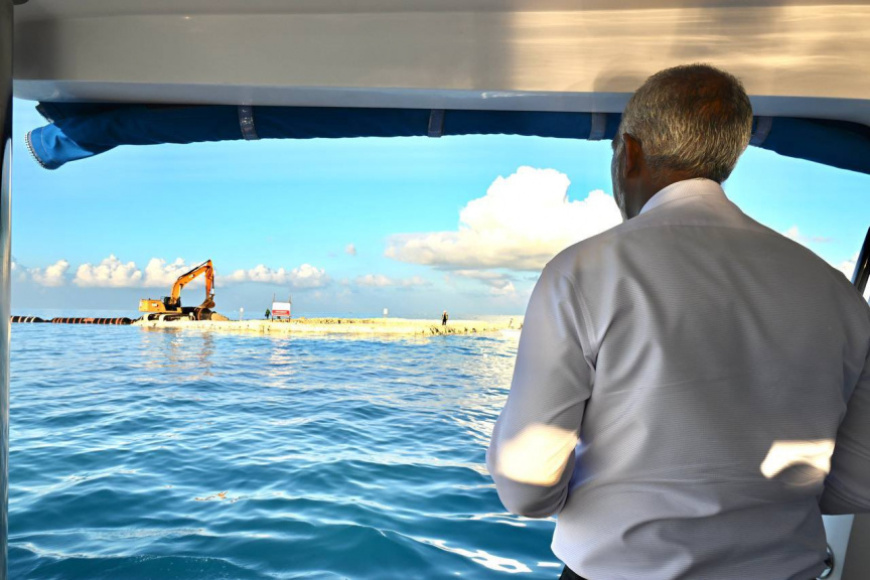
What should have been a highly technical, highly scrutinised infrastructure proposal was instead introduced through political theatre. Two years in, the tunnel’s reality is unchanged: it exists only in speeches, renderings, and public imagination.
A Debt-Ridden Nation Cannot Afford Prestige Dreams
Against the backdrop of these stalled promises is the Maldives’ economic reality, one that is uncomfortable and worsening. The country is classified as being at high risk of debt distress. The deficit remains deep. Borrowing costs are rising, and the nation is increasingly reliant on external support to service existing obligations.
Within this fragile fiscal environment, projects like Rasmale’ and the tunnel are not just ambitious, they are reckless. They require immense capital. They demand long-term financing arrangements the country is in no position to take on. Yet the government has offered no detailed, public cost estimates, no financing structure, and no debt sustainability analysis.
Instead, much of the financing appears to be pushed quietly onto entities like HDC, whose debts are ultimately borne by the public, even though those obligations sit outside the central government's balance sheet. It is debt hidden in plain sight, debt that future generations will pay for long after the political fanfare has passed.
Governance by Announcement, Not Accountability
A pattern emerges when examining the administration’s approach: major projects are unveiled with sweeping promises, timelines are bold, details are sparse, and transparency is minimal. Critical contracts are awarded quietly, concerns about environmental impact are brushed aside, and financing models shift without public explanation.
This governance style thrives on spectacle. It prioritises announcements over analysis, photo opportunities over feasibility, and political branding over long-term planning. But as the Maldives teeters on the edge of fiscal instability, this style of governance is becoming not just irresponsible but dangerous.
The Risk of Letting Fantasy Run the Country
The Maldives is already grappling with urgent needs: climate adaptation, coastal protection, debt management, healthcare investment, housing solutions for existing populations, and strengthening of local governance. These are not optional priorities, they are existential.
Every rufiyaa directed toward an unfinished mega-city or an underwater dreamscape is a rufiyaa not directed toward keeping real communities safe from storms, protected from erosion, or equipped with essential services.
President Muizzu’s supporters may argue that ambition is necessary. But ambition without realism is not leadership, it is fantasy. And fantasy built on debt is a direct threat to national stability.
Two years into his tenure, the president’s biggest promises remain stuck in the mud, literally and figuratively. Rasmale’ is incomplete, undefined, and unfunded. The underwater tunnel has not taken a single step forward. And the Maldives continues to face rising debt, economic warnings, and a lack of clarity about how these projects will be paid for.
These are not visionary achievements. They are unfolding failures. And unless the government confronts fiscal reality with honesty and discipline, the Maldives risks anchoring its future to projects that were never meant to leave the drawing board.







What's Your Reaction?